

Planning a Tanzania travel itinerary is harder than it looks. Distances are long, parks are spread across the north and south, and a bad route can cost you two full days in a car. Add Kilimanjaro or Zanzibar, and the puzzle gets bigger.
Here is the short answer. For most first-timers, the best Tanzania itinerary is 7 to 10 days that links the northern circuit (Tarangire, Serengeti, Ngorongoro Crater) and ends with a few beach days on Zanzibar. Shorter trips work with 5 days and a fly-in route. Longer ones leave room for a Kilimanjaro climb. Order matters more than the number of parks.
We are a locally owned operator in Arusha, and we build these routes every week for travelers like you. This guide lays out sample plans for 5, 7, 10 and 14 days, with day-by-day stops, typical costs per person, lodging options from luxury lodges to simple camps, and the timing tips that save money. Use it as a Tanzania trip planner, then adjust it to your dates and budget.
What to know before you plan your Tanzania trip
Before you pick dates or parks, get three basics straight: how the country is laid out, what paperwork you need, and how long the travel between stops really takes. Skip them and even a good Tanzania trip planner will hand you a route that looks great on paper and wears you out on the ground. Ten minutes here will save you days later.
Know the two main safari circuits
Tanzania is larger than Texas, and its parks sit in clusters. The northern circuit around Arusha holds Tarangire, Lake Manyara, Ngorongoro Crater and the Serengeti. It has the most lodges, the best roads and the Great Migration, so it suits almost every first-timer. The southern circuit is quieter and better for a second visit.
| Area | Main parks | Gateway | Best for |
|---|---|---|---|
| Northern circuit | Serengeti, Ngorongoro, Tarangire, Manyara | Arusha (Kilimanjaro Airport) | First-timers, Big Five, migration, 5 to 10 days |
| Southern circuit | Nyerere, Ruaha | Dar es Salaam | Repeat visitors, boat and walking safaris, fewer vehicles |
| Coast | Zanzibar, Mafia Island | Zanzibar City | Beach days after safari |
Pick one circuit per trip. Splitting a short holiday between north and south means extra flights and lost game-drive time. Every good Tanzania travel itinerary starts with that choice.
Tanzania is big, so every extra park costs you a day in transit, not an hour.
Check entry and health requirements
Most visitors need a visa, and you can apply online before you fly. Rules and fees change, so confirm them on the official immigration site a few weeks before departure, and see our Tanzania travel tips for more. Here is the checklist we send to every guest:
- A passport valid for at least six months after arrival, with blank pages.
- An e-visa, or cash for a visa on arrival at major airports.
- A yellow fever certificate if you arrive from or transit through a risk country. Kenya counts, which matters for combined trips.
- A malaria plan agreed with your doctor. The CDC page for Tanzania lists current advice.
- Travel insurance that covers medical evacuation, and altitude if you plan to climb.
Book flights only after your passport is sorted. A renewal can take longer than your trip planning.
Understand how long travel really takes
Distances on the map mislead you. Roads inside the parks are slow and often bumpy, and you will stop for animals. Budget for driving time and treat the figures below as typical, not exact.
| Route | Road time | Flight time |
|---|---|---|
| Arusha to Tarangire | 2 to 2.5 hours | n/a |
| Arusha to Lake Manyara | 1.5 to 2 hours | n/a |
| Arusha to Ngorongoro rim | 3.5 to 4 hours | n/a |
| Ngorongoro to central Serengeti | 4 to 6 hours with game viewing | n/a |
| Arusha to Serengeti | 8+ hours | About 1 hour 15 minutes |
| Arusha to Zanzibar | n/a | About 1.5 to 2 hours |
On a 5-day trip, a short flight into the Serengeti can save most of a day. On 10 days or more, driving makes sense because the journey is part of the safari.
Step 1. Choose your trip length and route
Trip length decides everything else, so settle it first. Count nights on the ground, not days on the calendar, because arrival and departure days are mostly travel. A 7-day holiday usually gives you 5 or 6 usable days, and the best Tanzania itinerary is the one that fits that number honestly.
Match your days to a route
This table shows what each trip length can realistically hold on the northern circuit.
| Total days | Safari nights | What fits | Add-on that fits |
|---|---|---|---|
| 5 | 3 | Tarangire and Ngorongoro, or a fly-in Serengeti | None |
| 7 | 4 to 5 | Tarangire, Serengeti, Ngorongoro | Beach time is tight |
| 10 | 6 to 7 | Full northern loop, 2 to 3 Serengeti nights | 3 beach days |
| 14 | 5 to 8 | Full loop with Lake Manyara | Kilimanjaro climb, or 5 to 6 beach days |
Give each stop two nights
Most first-timers try to see too much. One-night stops mean you pack every morning and spend the afternoon in a car. Two nights per stop lets you do a full game drive at dawn and a second one in the evening light.
The exceptions are Ngorongoro Crater and Tarangire, where one night often works. The Serengeti is the opposite. It is huge, so give it two or three nights if your budget allows.
Fewer parks with more nights each will always beat a long list of rushed stops.
Build your route in four moves
If you are wondering how to plan a Tanzania safari itinerary from scratch, work through this order:
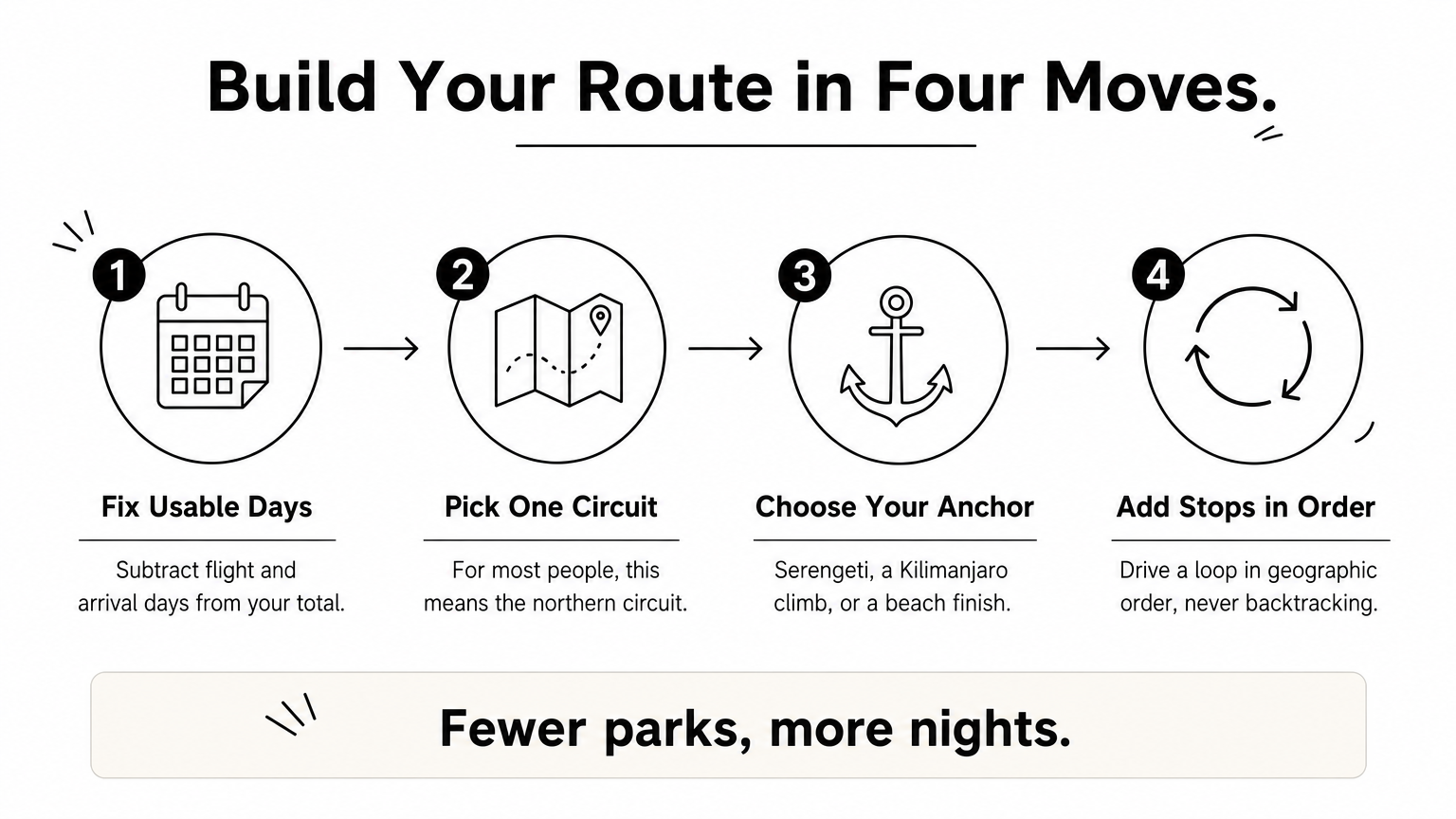
- Fix your usable days, after subtracting flight and arrival days.
- Pick one circuit, which for most people means the north.
- Choose your anchor: the Serengeti, a Kilimanjaro climb, or a beach finish.
- Add the remaining stops in geographic order, so you drive a loop instead of backtracking.
A typical loop runs from Arusha to Tarangire, then the Serengeti, then Ngorongoro, then back to Arusha. Once the loop works, the rest of your Tanzania travel itinerary falls into place around it.
Step 2. Pick the best time to travel
Timing shapes your Tanzania travel itinerary as much as the route does. Wildlife is good all year, but what you see and what you pay change sharply by month. Pick your month using the best time for Tanzania safari before you book lodges, because the best camps fill first.
Read the seasons month by month
There are two dry seasons and two rainy ones. The long dry season from June to October gives the easiest game viewing, because animals crowd around shrinking water and the grass is short. It is also the most expensive stretch of the year.
| Months | Conditions | Wildlife highlight | Prices |
|---|---|---|---|
| Jan to Feb | Hot, short dry spell | Calving season in the southern Serengeti and Ndutu | High |
| Mar to May | Long rains | Green, quiet parks, a few camps close | Lowest |
| Jun to Oct | Dry and cool | Best overall, river crossings in the north from July | Peak in Jul and Aug |
| Nov to Dec | Short rains | Herds move south, great birding | Mid, peak at Christmas |
Match the migration to your dates
Forget the idea of a single "migration season." The herds circle the Serengeti all year, so your month decides which region you should sleep in. Calving happens around Ndutu from January to March. Western corridor crossings come in June and July. The Mara River crossings in the north peak from late July to October.
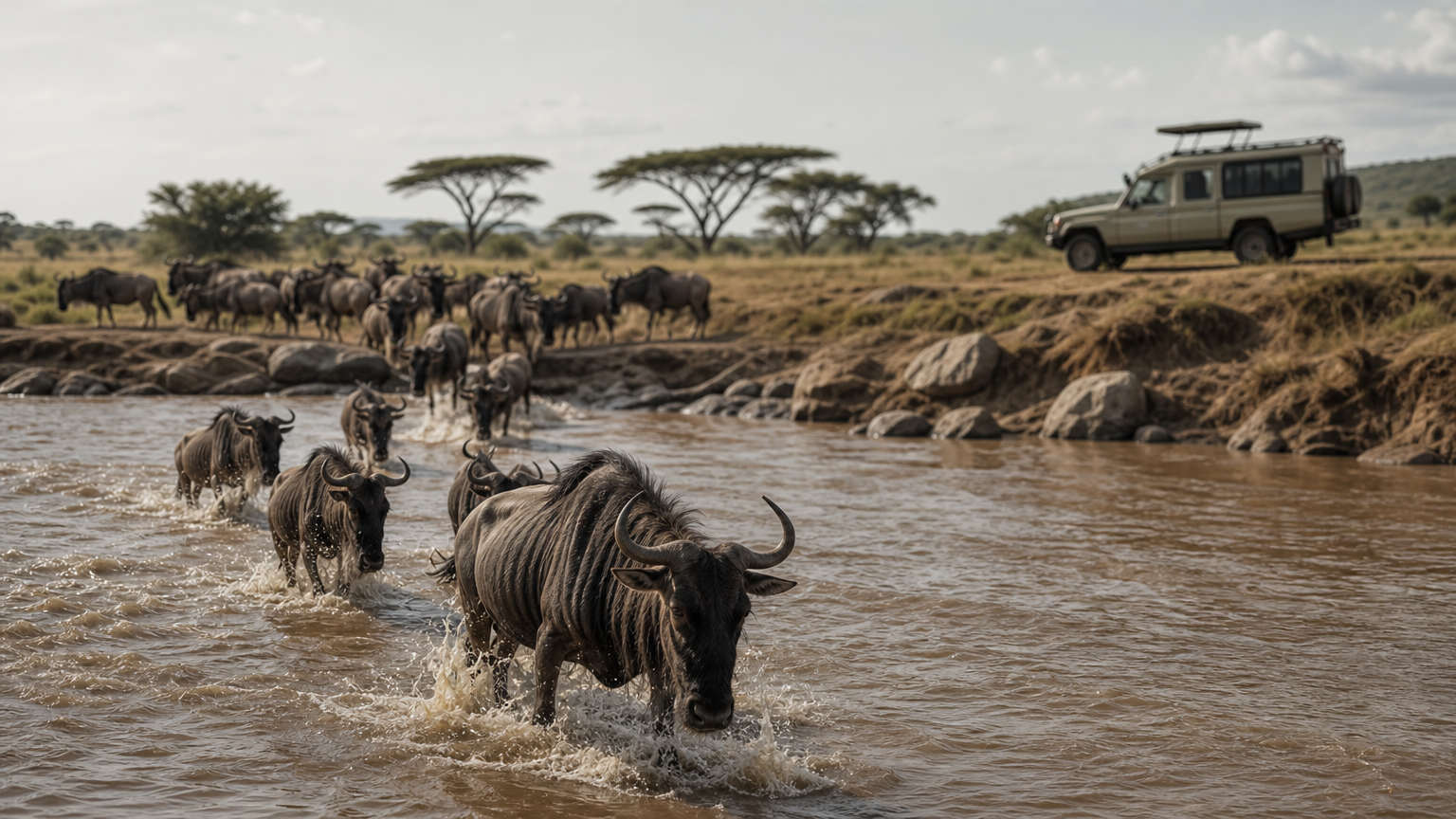
Choose your month first, then let the month decide which part of the Serengeti you stay in.
Rain shifts the herds by a few weeks either way, so treat these as windows, not promises. Any honest operator will tell you river crossings can’t be guaranteed. Tarangire is the exception that proves the rule: it is best from June to October, when elephants gather on the river.
Save money in the shoulder months
Late May, early June and November often bring lower lodge rates and fewer vehicles at each sighting. April and early May are the wettest weeks. Roads turn muddy and some camps shut, so I would skip them unless price matters most.
Your add-ons have their own windows:
- Kilimanjaro: January to March and June to October have the clearest trails.
- Zanzibar: June to October is dry and breezy. December to February is hotter and more humid. Avoid April and May.
- Peak crowds: July, August and the Christmas weeks. Book six to nine months ahead.
Step 3. Set a realistic budget
Money decides your lodging tier and how many days you can afford, so set a number before you book anything. Safari pricing is quoted per person per day, and three things drive most of the cost: lodging level, park fees and a private vehicle. Fix a total budget now so your Tanzania travel itinerary does not get rebuilt later.
Know the daily cost by style
Expect these ranges for a private 4×4 with a driver-guide, per person per day, based on two people sharing. They are typical figures, not quotes, and prices rise in peak season.
| Style | Per person per day | Typical lodging |
|---|---|---|
| Budget | $250 to $350 | Basic camps, simple lodges |
| Mid-range | $400 to $600 | Comfortable lodges, tented camps |
| Luxury | $700 to $1,200+ | Premium lodges, private camps |
A 7-day mid-range trip with five safari days lands around $3,000 to $4,200 per person before international flights. Solo travelers pay a single supplement, so expect more.
Budget per day on safari, then add flights, tips and extras on top.
Check what the price includes
Park fees are the biggest hidden variable in Serengeti safari package costs. The Serengeti and Ngorongoro charge per person, per 24 hours, plus a vehicle fee, and the government updates rates often. Ask every operator whether the quote includes them, and confirm current rates on the official park authority websites.
- Usually included: lodging, meals, park fees, private vehicle, fuel and guide.
- Usually extra: international flights, visas, tips, drinks, insurance and domestic flights.
Plan on roughly $20 to $30 per day in tips for your guide and a little more for the camp staff.
Price your add-ons separately
Add-ons change the total fast. A Kilimanjaro climb of 7 to 8 days costs about $2,000 to $3,500 per person, depending on route and group size. Zanzibar runs from $80 per room night for a simple guesthouse to $400 or more for a beachfront resort. Short fly-in hops to the Serengeti add several hundred dollars per person each way.
Trim costs without ruining the trip
For cheap Tanzania safari tours, shoulder months give you the biggest saving, often 20 to 30 percent off lodge rates. Next, share the vehicle. A private 4×4 seats up to six, so a family or small group splits one cost. Finally, cut parks, not nights. Two nights in fewer places costs less in fees and transit than a rushed circuit.
Step 4. Build your northern circuit safari days
Now turn the route into real days. The northern circuit rewards a loop, so you drive in one direction and never retrace your tracks. Each park offers something different, and knowing that helps you decide what to keep and what to cut.
Know what each park gives you
Treat the Serengeti and Ngorongoro as your non-negotiable stops. Tarangire and Lake Manyara are flexible, so trim them first when days run short.
| Park | Best for | Nights |
|---|---|---|
| Tarangire | Big elephant herds, baobabs, best June to October | 1 to 2 |
| Lake Manyara | Birdlife, forest scenery, short visit | Half day to 1 |
| Central Serengeti (Seronera) | Lions, leopards, cheetahs all year | 2 to 3 |
| Ngorongoro Crater | Black rhino, dense wildlife inside a caldera of roughly 260 square km | 1 |
On a 5-day trip, skip Manyara. On 10 days or more, add it as a gentle first or last stop.
Sequence your days
Here is the loop for a 7-day trip with four safari nights. It matches the best Tanzania itinerary pattern we use for most first-timers.
- Day 1: Arusha to Tarangire. Check in, then take an afternoon game drive.
- Day 2: Tarangire to the central Serengeti. This is the longest drive, so leave by 7 a.m. and watch for game along the way.
- Day 3: A full day in the Serengeti, with a dawn drive and an evening drive.
- Day 4: A final morning drive, then continue to the Ngorongoro rim.
- Day 5: Descend into the crater at first light, then return to Arusha.
Days 6 and 7 are your buffer for flights, or the start of a beach extension.
Put your longest drive on a transfer day, never on the day you most want to see animals.
Plan the drive days around the light
Animals are most active at dawn and the last two hours before sunset. Midday is for lunch, a pool or a long transfer. Ask your guide to build the schedule this way, and your Tanzania travel itinerary will feel less like a bus tour.
Visits on a Ngorongoro Crater safari are usually limited to about six hours, so start the descent early. Arrive at the floor by 7 a.m. and you will have the best light and fewer vehicles.
Step 5. Decide whether to add Kilimanjaro
Climbing Kilimanjaro is the one add-on that reshapes your whole Tanzania travel itinerary. The climb alone takes 6 to 9 days, plus a rest day on each end. Add it only if you are fit, enjoy multi-day hiking, and have 12 to 14 days or more in total. A 7-day holiday has no room for it, and a rushed attempt usually ends in a turnaround below the summit.
Pick a route that gives you time to adjust
The summit sits at 19,341 feet (5,895 m), and altitude is the real challenge, not the terrain. Longer routes have better summit rates because your body gets more days to adapt. Here is how the main options compare.
| Route | Days on the mountain | What to expect |
|---|---|---|
| Marangu | 5 to 6 | Sleeps in huts, short, lower success rate |
| Machame | 6 to 7 | Scenic and popular, can be busy |
| Lemosho | 7 to 8 | Quieter, strong acclimatization, our usual advice |
| Northern Circuit | 9 | Longest route, highest summit success |
Choose the longest route your calendar allows, because one extra night is the cheapest protection against altitude sickness.
Budget $2,000 to $3,500 per person for 7 to 8 days, as noted in your budget step. Ask each operator about safety before you compare prices. Look for daily health checks, a pulse oximeter, emergency oxygen and a clear evacuation plan.
Climb first, then safari
If you book a Kilimanjaro climb and safari package, put the mountain at the start of the trip. After a week of hiking, your legs will welcome a vehicle seat and a lodge bed, and the safari becomes your recovery. If you reverse the order, you arrive at the trailhead tired from early game drives.
Plan a buffer as well. Never book a flight home on the day you descend. Keep one night in Arusha or Moshi for a hot shower, laundry and a margin if weather delays you.
Test yourself before you commit
Not sure you are ready? Try a warm-up first. A day hike up Mount Longido near Arusha shows how your legs and lungs handle a steady climb. Before you pay a deposit, run through this short list:
- Hike 3 to 4 hours with a loaded daypack at home, twice a week for two months.
- See your doctor about altitude medication and your fitness.
- Confirm that your travel insurance covers trekking up to 19,341 feet.
If the climb feels like too much, skip it. A northern safari with beach days still makes one of the best Tanzania itinerary options, and nobody leaves disappointed.
Step 6. Add Zanzibar or other beach time
A beach finish turns a hard-working safari into a full holiday. After several dawn starts, three to five beach nights feel right. Fewer than three and transfers eat the rest. Zanzibar is the default pick for a Tanzania travel itinerary because the flight from Arusha takes about 1.5 to 2 hours, and you can reach the coast within a day of your last game drive.
Choose your part of Zanzibar
The island is small, but the coastlines feel very different. Pick the area before you pick a hotel.
| Area | Feel | Best for |
|---|---|---|
| Stone Town | Historic, busy | 1 night, spice tours, old town walks |
| Nungwi and Kendwa | Lively, north coast | Swimming at any tide, sunsets |
| Paje and Jambiani | Relaxed, east coast | Kitesurfing, long beach walks |
| Matemwe | Quiet, northeast | Snorkeling trips to Mnemba Atoll |
Tides matter more than most guides admit. On the east coast the sea retreats far at low tide, so swimming depends on the clock. If you want a dip whenever you like, choose the north coast.
Pick your Zanzibar beach for the tide and the mood, not for the photo on the booking page.
Consider other beach options
Zanzibar is not the only choice. Mafia Island is quieter, with excellent diving and whale shark season roughly from October to March. Pemba suits divers who want empty reefs. If you finish a southern circuit safari, the coast near Dar es Salaam saves you a flight. Combining Tanzania with Kenya? Diani Beach is the natural stop.
Rates vary a lot. Expect about $80 per room night for a simple guesthouse and $400 or more for a beachfront resort, as covered in your budget step.
Time the beach days well
Safari first, beach last, which is how a Tanzania Zanzibar safari usually works. You get a slow, sandy recovery after the long drives, and you avoid hauling wet swimwear through the parks. Keep the weather in mind too. June to October is dry and breezy, while April and May bring heavy rain and some closed resorts.
Book your flight home with care. Leave a buffer night before any long-haul departure, because island weather and airline schedules can shift. A simple Zanzibar block looks like this:
- Night 1: Stone Town, for history and a spice tour.
- Nights 2 to 4: your chosen beach, with one snorkeling or sandbank trip.
- Final day: a slow morning, then your flight.
Step 7. Choose lodging and a safari operator
Lodging and your operator shape the trip more than any single park does. Where you sleep decides how much you drive each morning, and who guides you decides what you actually see. Settle both before you pay a deposit, because neither is easy to fix once you land.
Match lodging to your route
Three styles cover most northern circuit trips. Pick by how close you want to be to the wildlife, not by the brochure photos, and see our picks of the best safari lodges in the Serengeti.
| Type | What it is | Best for |
|---|---|---|
| Safari lodge | Permanent rooms, pool, restaurant | Families, first-timers, rest days |
| Tented camp | Canvas on a platform, en-suite bathroom | Mid-range and luxury, closer to nature |
| Basic camp | Simple tents, shared facilities | Budget travelers, short stays |
Location beats luxury. A modest camp inside the park or near the gate can save you an hour of driving each day, and that hour is worth more than a spa. In the Serengeti, choose the area that matches your month from Step 2, because the herds decide the best base.
Vet the operator before you pay
Operators differ far more than lodges do. Ask every company the same questions, and compare the written answers side by side, as in our review of Serengeti safari tour operators:
- Does it hold a current tour operator license, and is it a member of the Tanzania Association of Tour Operators?
- Is the 4×4 private, with a window seat for every guest?
- Which park fees, domestic flights and tips are in the price?
- Who is my guide, and how many years has he worked these parks?
- What is the emergency and evacuation plan?
- Does the quote name every lodge and every night?
A cheap quote that hides park fees is not cheap, just unfinished.
Read reviews for guide names, not star ratings. When travelers mention the same guide again and again, you are looking at consistent work rather than one lucky trip.
Test their communication
Send your dates and budget by email or WhatsApp and watch what happens. A team that replies in hours with a clear, tailored Tanzania travel itinerary will also answer fast when a flight changes halfway through your trip. Vague replies, pressure to pay a large deposit upfront and fixed group departures sold as "private" are all red flags.
A local operator based in Arusha also knows which camps are full, which roads are washed out and which guides are free on your dates. That local knowledge rarely appears in a price comparison, yet it shapes your days more than any line in the quote.
Step 8. Sort out logistics and packing
Logistics feel dull until something goes wrong. Most problems on a Tanzania travel itinerary come from flights, cash and luggage, not from animals. Fix these three areas now, and the safari days run smoothly.
Book flights and transfers
For the northern circuit, fly into Kilimanjaro International (JRO), about 45 minutes from Arusha. Many long-haul flights land late at night, so arrive a day early and sleep in Arusha. Do the same at the end. A buffer night before your flight home protects you from a late vehicle or a weather delay.
Arrive a day early and pack soft bags, and most logistics problems never happen.
Small planes to the Serengeti and Zanzibar have strict luggage rules:
- Use a soft duffel bag. Hard suitcases do not fit in the cargo hold.
- Expect a limit of about 33 lb (15 kg) per person, carry-on included.
- Leave spare clothes in storage at your Arusha hotel.
Carry cash and stay connected
Bring clean US dollar bills printed in 2009 or later, because older notes are often refused. ATMs work in Arusha and Zanzibar, but parks and camps have none. Carry small bills for tips and keep them in a separate pouch. A local SIM or an eSIM costs little, and WhatsApp works well for staying in touch with your operator, though lodge Wi-Fi is patchy.
Pack for the game drive
Mornings on the crater rim, at roughly 7,500 feet, can feel close to freezing. By noon you will be in a T-shirt. Dress in layers and keep a fleece and windproof jacket within reach. Choose neutral colors like khaki, olive and tan, as our guide on what to wear on safari in Tanzania explains. Avoid black and dark blue, which attract tsetse flies in Tarangire and the Serengeti woodlands.
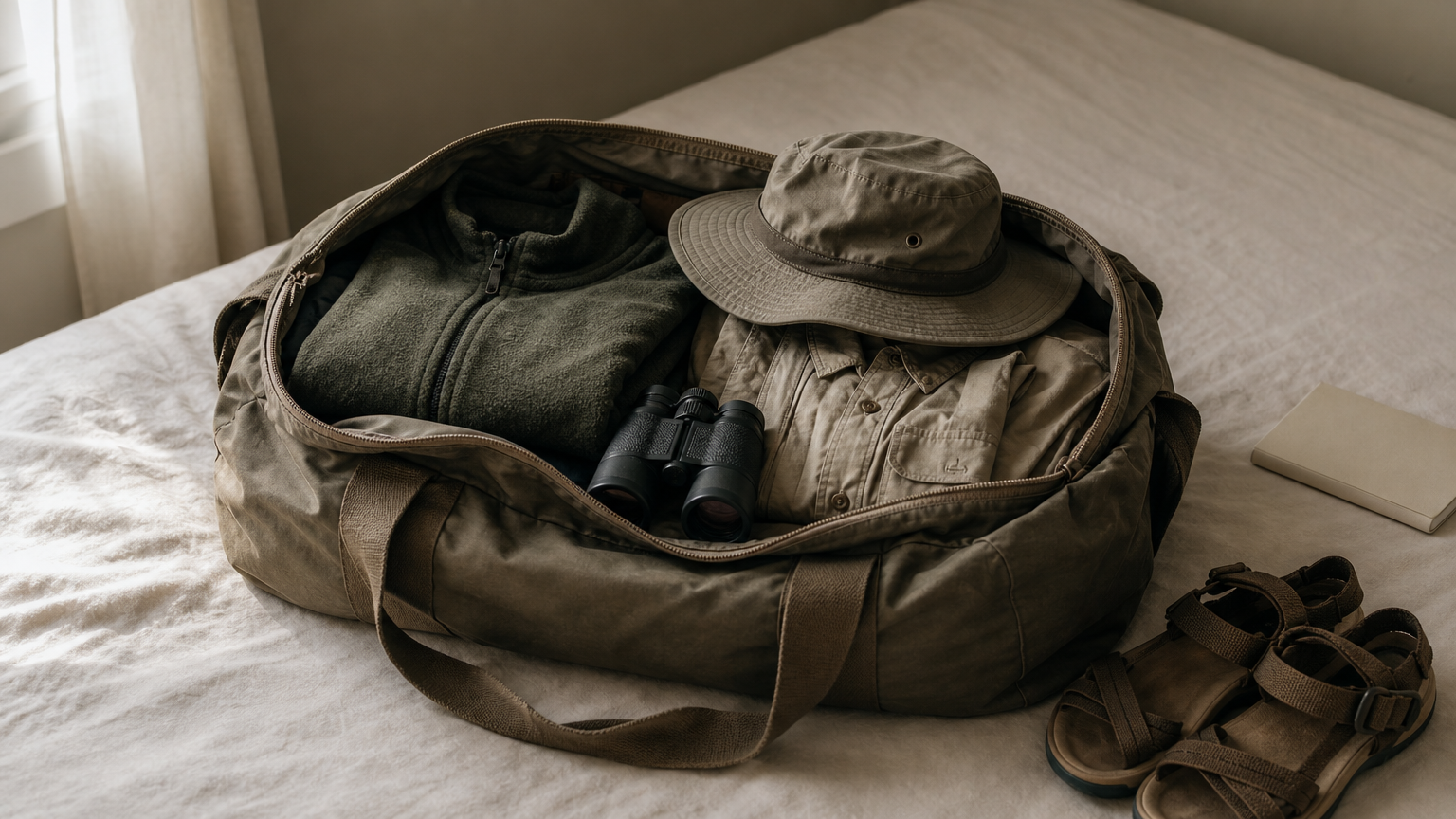
Here is a compact checklist, and our Tanzania safari packing list covers the rest:
- Two or three quick-drying shirts and convertible trousers
- Wide-brim hat, sunglasses and SPF 50 sunscreen
- Binoculars, 8×42 is a good size
- Insect repellent and your prescription medicines
- Power bank and a type D or G plug adapter
- Closed shoes and one pair of sandals
Two rules catch travelers out. Camouflage clothing is illegal for civilians in Tanzania, so leave it at home. Plastic bags are also banned, so use cloth or paper bags for your toiletries.
Sample itineraries for 5, 7, 10 and 14 days
Here are four plans built from the steps above. Each one is a loop, so you never backtrack. Treat them as a starting point in your own Tanzania trip planner, then shift nights to match your month and adjust the lodging tier to your budget.
Short trips: 5 and 7 days
Five days only works well with a fly-in Serengeti plan, because driving would eat the whole trip. Seven days gives you the classic loop from Step 4, with room to rest before your flight.
5 days, 3 safari nights:
- Day 1: Fly from Arusha to the Serengeti, with an afternoon game drive.
- Day 2: Full day in the central Serengeti.
- Day 3: Drive to the Ngorongoro rim, with game viewing on the way.
- Day 4: Crater at dawn, then back to Arusha.
- Day 5: Fly home.
7 days, 4 safari nights:
- Day 1: Arusha to Tarangire.
- Days 2 to 3: Drive to the Serengeti, then a full day there.
- Day 4: Morning drive, then the Ngorongoro rim.
- Day 5: Crater, then Arusha.
- Day 6: Rest and shop in Arusha.
- Day 7: Fly home.
Longer trips: 10 and 14 days
Ten days is the sweet spot for most travelers. It holds a full northern loop plus three beach nights, which makes it our usual pick for the best Tanzania itinerary on a first visit. Fourteen days adds either Kilimanjaro or a longer coast stay.
10 days, 6 safari nights and 3 beach nights:
- Day 1: Tarangire.
- Days 2 to 4: Serengeti, three nights.
- Day 5: Ngorongoro rim.
- Day 6: Crater, then Lake Manyara.
- Day 7: Back to Arusha, then fly to Zanzibar.
- Days 8 to 9: Beach.
- Day 10: Fly home.
14 days with Kilimanjaro:
- Day 1: Arrive and sleep in Arusha.
- Days 2 to 9: Lemosho route, 8 days.
- Day 10: Rest night in Arusha.
- Days 11 to 13: Fly-in Serengeti, then Ngorongoro.
- Day 14: Fly home.
Prefer no mountain? Run the 10-day loop, then add 4 more beach nights.
Compare the four at a glance
Prices below are typical mid-range figures per person, based on two sharing, and exclude international flights.
| Trip | Safari nights | Add-on | Typical cost |
|---|---|---|---|
| 5 days | 3 | None | $1,900 to $2,900 |
| 7 days | 4 | Optional rest | $3,000 to $4,200 |
| 10 days | 6 | 3 beach nights | $3,800 to $5,800 |
| 14 days | 3 | 8-day climb | $5,000 to $7,500 |
Pick the plan that matches your usable days, then add nights before you add parks.
Any of these can become your own Tanzania travel itinerary once you lock your dates, so send them to your operator and ask for a written day-by-day quote.
Ready to turn your plan into a trip
A good Tanzania travel itinerary comes down to a few honest choices. Count your usable days, stay on one circuit, match your month to the right part of the Serengeti, and give each stop two nights. Add Kilimanjaro or Zanzibar only when your calendar and budget can carry them.
Everything else is detail, and details are easier with someone who knows the ground. Ask every operator for a written, day-by-day quote that names each lodge and each park fee. Remember that fewer parks with more nights beats a rushed list every time.
You now have the steps, the costs and four sample routes. Send your dates and budget to our team in Arusha, and we will shape them into a tailor-made itinerary with a local guide you can name before you land. Start with a free trip quote on one of our Tanzania tour packages and see your days laid out.