

So you’re planning a Kilimanjaro climb and the trip planning tool keeps asking for your itinerary length, but nobody’s given you a straight answer on how long does it take to climb Kilimanjaro. That’s a fair question, because the answer changes your budget, your fitness prep, and your odds of actually reaching the summit.
Here’s the direct answer: most climbers spend 5 to 9 days on the mountain, depending on the route. Shorter routes like Marangu can technically be done in 5 days, but we rarely recommend it. Longer routes like Lemosho or Northern Circuit stretch to 8 or 9 days, giving your body more time to acclimatize to the altitude, which is the single biggest factor in whether you summit successfully or turn back with altitude sickness.
In this article, we’ll break down how each route affects your total trip length, why extra days on the mountain directly improve your summit success rate, and how to pick an itinerary that fits your fitness level, schedule, and budget. We climb this mountain constantly, so we’re going straight to what actually matters for your planning.
Why the number of days you choose determines your success
Every extra day you spend on Kilimanjaro is a day your body gets to adjust to lower oxygen levels, and that single variable predicts your summit outcome more reliably than fitness level, age, or gear quality. Kilimanjaro tops out at 19,341 feet, and above 10,000 feet your blood oxygen saturation starts dropping fast if you climb faster than your body can adapt. Climbers who compress the mountain into a rushed 5-day itinerary are gambling with altitude sickness, which is a big part of how hard it is to climb Kilimanjaro, and that gamble shows up in the summit statistics every operator tracks internally.
Altitude acclimatization is the real clock you’re racing
Gaining altitude too quickly overwhelms your body’s ability to produce the extra red blood cells and adjust breathing patterns needed to function with less oxygen. This is why guides obsess over the phrase "climb high, sleep low," a technique built into longer itineraries where you hike to a higher point during the day and descend to sleep at a lower camp. Shorter routes skip or shorten this technique because there simply isn’t time to add extra acclimatization loops. The World Health Organization and mountaineering medicine researchers agree that gradual ascent is the single most effective way to prevent acute mountain sickness, more effective than any medication.
Extra days on Kilimanjaro don’t just add scenery, they buy your body time to adapt to thin air, and that time is what actually gets you to Uhuru Peak.
Summit success rates by trip length
Operators who track outcomes across thousands of climbers consistently see the same pattern: summit success rates climb sharply as itinerary length increases. Here’s the general trend across the industry, based on data commonly cited by Kilimanjaro guiding companies and altitude researchers:
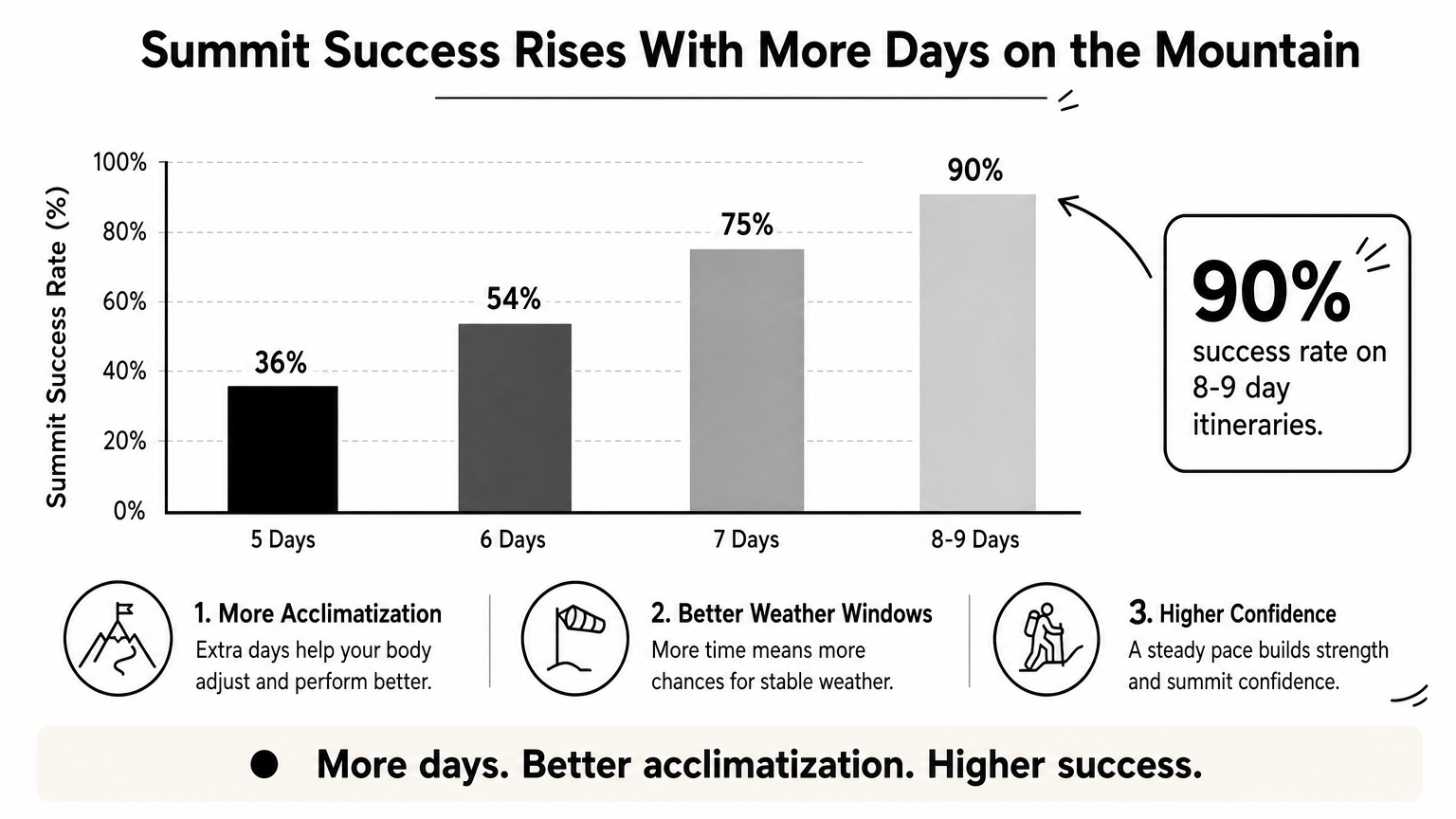
| Itinerary length | Typical summit success rate |
|---|---|
| 5 days | 27-45% |
| 6 days | 44-64% |
| 7 days | 65-85% |
| 8-9 days | 85-95%+ |
Finding these numbers surprising is normal, most first-time climbers assume fitness matters more than schedule. It doesn’t. A marathon runner on a 5-day Marangu itinerary is more likely to turn back with a pounding headache and nausea than a moderately fit hiker on an 8-day Lemosho route. The extra nights at altitude do the work that cardio fitness can’t.
Why rushing costs more than it saves
Getting a shorter itinerary looks cheaper on paper, since you pay for fewer park fees, fewer guide days, and fewer nights of camping equipment rental. But run the math on what you’re actually buying: if a 5-day climb costs you $200 less than a 7-day climb but cuts your odds of standing on the summit roughly in half, you’re not saving money, you’re paying full price for a coin flip. Most climbers who fail on a rushed itinerary don’t get a refund and don’t get a second attempt during that trip.
Honestly, we tell every client the same thing when they ask us to shave a day off their itinerary to save money: don’t do it unless your schedule truly leaves no other option. We build our own Kilimanjaro trekking packages around 7 to 9 day itineraries specifically because we’ve watched shorter trips send tired, altitude-sick clients back down without a summit photo. The extra day or two isn’t padding, it’s the part of the trip that actually determines whether the rest of it was worth doing.
How to choose the right climb duration for you
Picking your ideal itinerary length isn’t about finding the shortest option that fits your calendar, it’s about matching the climb to your body, your budget, and your goals. Ask yourself how long you can realistically be away from work, how much altitude experience you already have, and whether you’re climbing to bag a summit photo or to actually enjoy the trek. Answering these honestly narrows down how long to climb Mount Kilimanjaro far faster than scrolling through generic itinerary lists.
Match your fitness and altitude experience to route length
Question your assumptions about fitness here. Cardiovascular fitness helps you move comfortably on the trail, but it does nothing to speed up how fast your body produces red blood cells at altitude, which is how hard the Kilimanjaro climb really is for most people. If you’ve never slept above 8,000 feet, lean toward 7 to 9 days regardless of how many miles you run each week. If you’ve successfully summited other high peaks like Mount Whitney or Toubkal without symptoms, a 6 or 7 day route becomes a reasonable, if still calculated, risk.
The best itinerary length is the one that matches your altitude history, not your gym schedule.
Factor in your available vacation time honestly
Realistically, most travelers have 10 to 14 days total for the whole Tanzania trip, once you subtract international flights, a rest day in Arusha, and maybe a couple of days in Zanzibar afterward. That leaves 6 to 9 days for the actual climb, which lines up well with the routes we recommend most. Squeezing the mountain into a 5-day window to save two vacation days rarely pays off once you factor in the lower odds of reaching Uhuru Peak.
Weigh your budget against your summit odds
Similarly, budget matters, and affordable Kilimanjaro trekking tour packages do exist, but treat cost as one input, not the deciding factor. Compare the cost per extra day against the jump in summit success rate from the table above, and the math almost always favors adding a day. A rough guide:
- Tight budget, flexible schedule: add days before cutting them, since failed summits cost more in wasted trip value than an extra night on the mountain.
- Fixed schedule, flexible budget: book the longest route your calendar allows.
- Both fixed: talk to your operator about which route gives the best acclimatization per day, since not all itineraries use their days equally, and compare the trusted Kilimanjaro operators for 2026 before you commit.
Ultimately, this is exactly the conversation we have with every client through our free trip quotation tool, because the right duration depends on details a generic guide can’t account for.
How long each Kilimanjaro route takes to climb
Seven official routes lead to Uhuru Peak, and each one in our complete guide to every Kilimanjaro climbing trail comes with a standard duration range set by how the trail winds through the mountain’s ecological zones. Picking a route isn’t just about scenery, since route length and acclimatization profile are baked into the trail itself. Some paths simply can’t be stretched much beyond their standard length without repeating camps, while others were designed with built-in extra nights specifically to boost your odds of summiting.
Standard duration by route
Here’s how the seven main routes stack up in terms of typical trip length and general character:
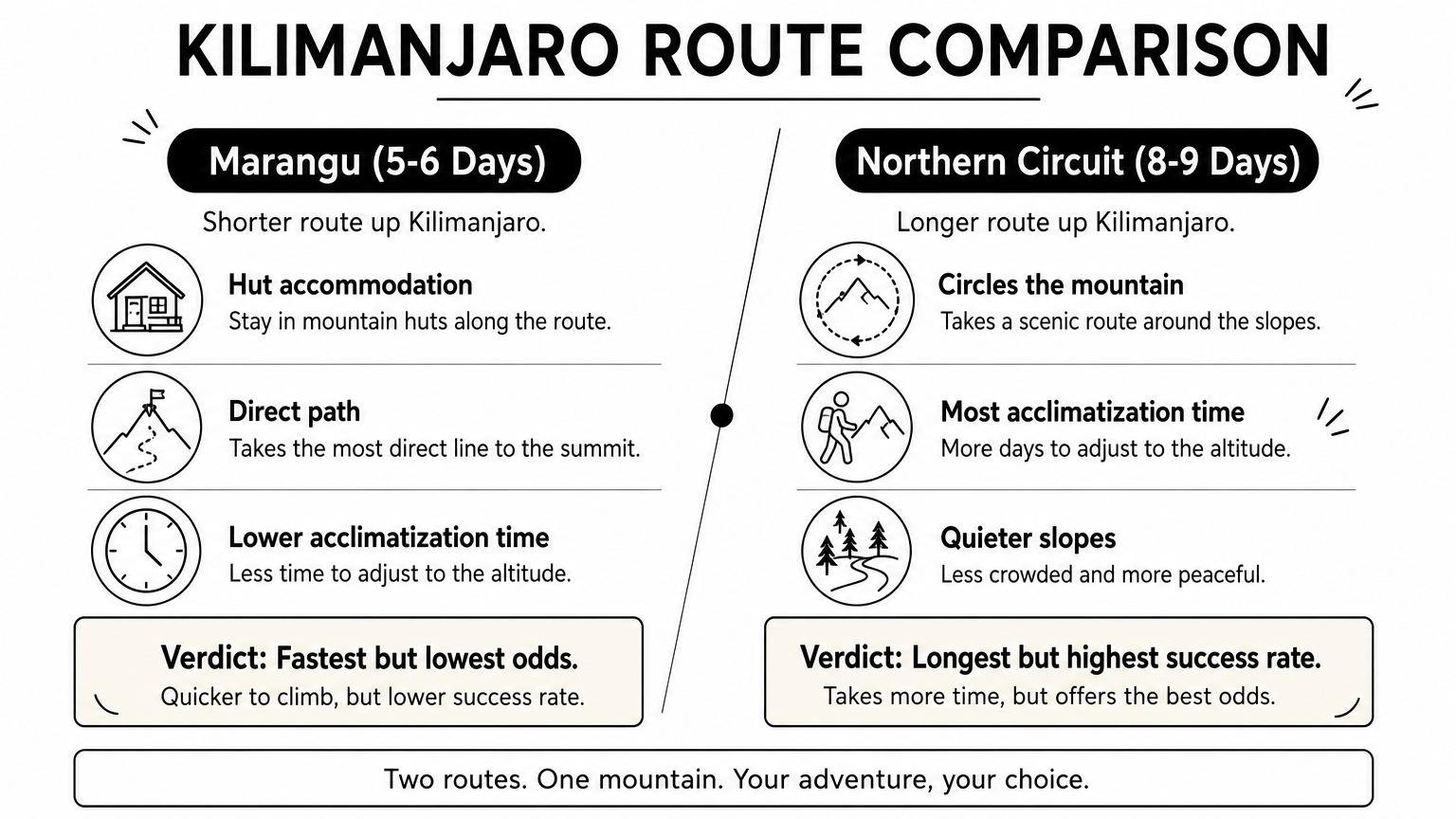
| Route | Typical duration | Notes |
|---|---|---|
| Marangu | 5-6 days | Only route with hut accommodation, shortest standard itinerary |
| Umbwe | 5-6 days | Steepest, most direct, not recommended for beginners |
| Machame | 6-7 days | Popular "Whiskey Route," scenic but demanding |
| Rongai | 6-7 days | Approaches from the north, gentler gradient |
| Shira | 7-8 days | Similar to Lemosho but starts higher, less acclimatization time |
| Lemosho | 7-8 days | Long, scenic, strong acclimatization built in |
| Northern Circuit | 8-9 days | Longest route, circles the mountain, highest summit success rates |
Two routes can lead to the same summit, but the number of nights on the mountain is what actually decides your odds of standing on top.
Why some routes are longer by design
Northern Circuit and Lemosho weren’t extended for tourism marketing, they were built to add acclimatization days on the mountain’s quieter northern and western slopes. That extra distance means more time at moderate altitude before you push toward the higher camps, which is exactly the buffer your body needs. Marangu, by contrast, follows a shorter, more direct line, which is why the 6-day Marangu route climb is popular with climbers on tight schedules but also why it posts some of the lowest summit success rates of any route.
Matching route length to your goals
Often, climbers assume the shortest route saves the most money, but Marangu and Umbwe frequently cost close to the same per-day rate as Machame or Lemosho once you factor in park fees and staffing. Given that, we usually steer clients toward the scenic Lemosho trek to Uhuru Peak or Machame for a first Kilimanjaro attempt, since both balance a manageable trip length with real acclimatization time. If you want the highest odds possible and your schedule allows it, Northern Circuit is worth the extra one or two days. You can compare these options directly through our Kilimanjaro climbing tours, where each itinerary lists exact daily distances and camp altitudes.
What a day-by-day Kilimanjaro climb looks like
Seeing an actual day-by-day breakdown makes the abstract idea of "7 days" or "9 days" much more concrete. Every itinerary follows the same basic shape: a gradual climb through rainforest, moorland, and alpine desert, a summit push in the middle of the night, and a fast descent. Below is a typical 7-day Machame schedule, one of the most common routes we run, so you can see exactly where those extra acclimatization days go.
A sample 7-day Machame itinerary
- Day 1: Machame Gate (5,900 ft) to Machame Camp (9,800 ft), hiking through rainforest
- Day 2: Machame Camp to Shira Camp (12,500 ft), moving into moorland terrain
- Day 3: Shira Camp to Lava Tower (15,190 ft) then down to Barranco Camp (13,000 ft), a classic "climb high, sleep low" day
- Day 4: Barranco Camp to Karanga Camp (13,100 ft), a short but steep day for extra acclimatization
- Day 5: Karanga Camp to Barafu Camp (15,300 ft), your final camp before the summit push
- Day 6: Midnight start from Barafu to Uhuru Peak (19,341 ft), then descend to Mweka Camp (10,065 ft)
- Day 7: Mweka Camp to Mweka Gate, exit the park
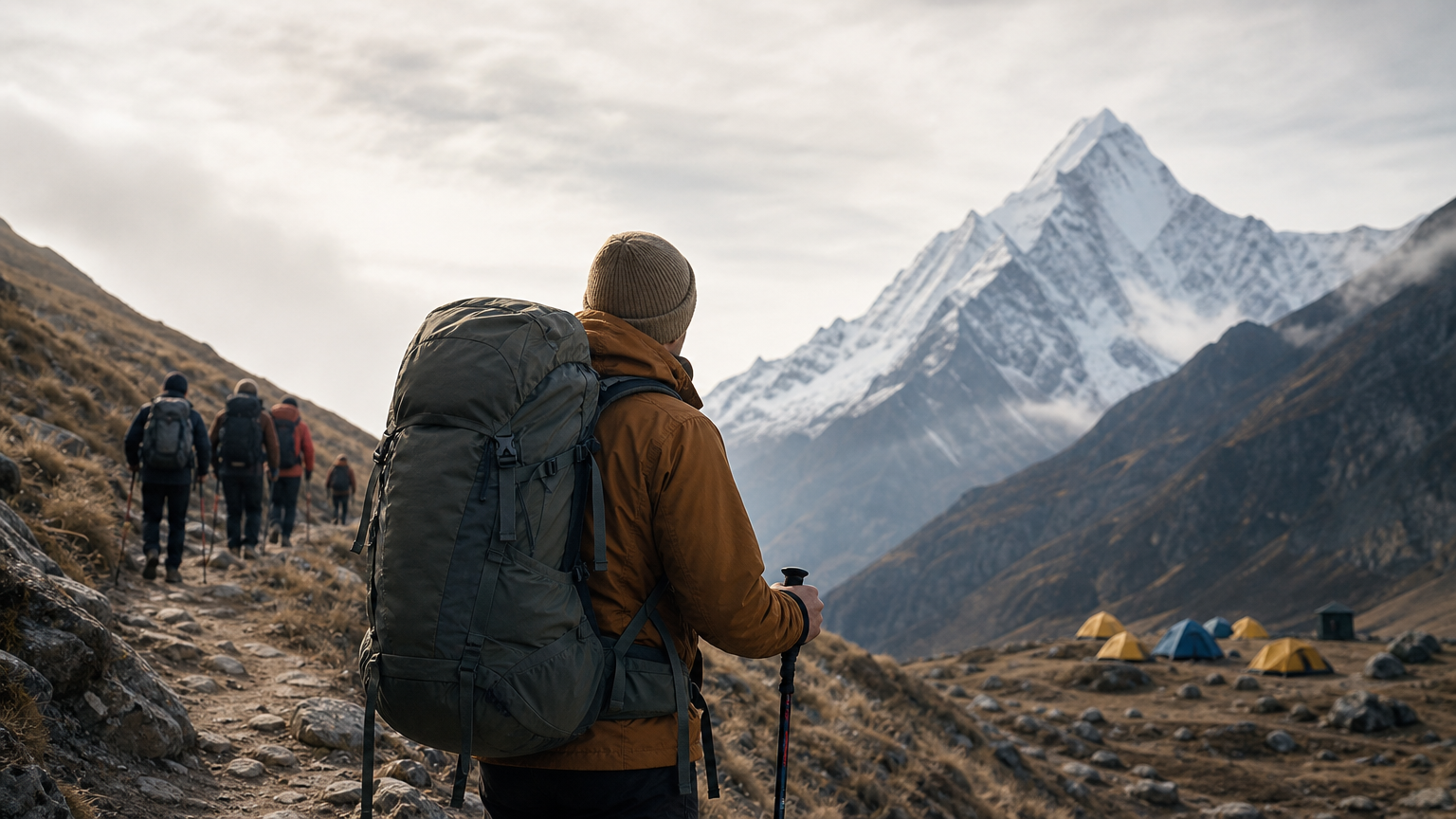
That single acclimatization day at Karanga Camp isn’t wasted time, it’s the difference between reaching Barafu Camp ready to climb and reaching it exhausted.
How shorter and longer versions compress or expand this pattern
Compressing this same route into a 6-day Machame climb usually means cutting the Karanga acclimatization day, which pushes you from Barranco straight to Barafu in one long stretch. That saves a night of camping fees, but it also removes the exact buffer that helps your body adjust before the hardest section of the climb. Extending it to 8 or 9 days on Lemosho or Northern Circuit adds one or two more nights at moderate altitude before you ever reach Barafu, spreading the elevation gain across more sleeping stops instead of fewer.
Notice the pattern here: the summit night and descent almost never change length regardless of route, since that part of the mountain is physically the same distance no matter which path you took to get there. What changes is everything before it, the number of nights your body gets to adjust before that final push. That’s why two climbers can start on different routes, both spend the same single night pushing for the summit, and end up with very different experiences based entirely on how their prior days were structured.
Other factors that change how long your climb takes
Route choice sets your baseline, but several other variables can quietly add a day to your trip or shave one off without you ever changing your itinerary on paper. Weather delays, group pace, and even the season you climb in all interact with your chosen route length, sometimes stretching a planned 7-day Machame trek into an 8-day trek once you factor in a slow group or a storm that pins you at camp for half a day. Understanding these factors helps you build in a realistic buffer instead of assuming your printed itinerary is guaranteed to match your actual days on the mountain.
Weather and seasonal timing
January through March and June through October are Kilimanjaro’s driest windows, so the season you pick for your Kilimanjaro climb matters, and climbing outside them can add unplanned time if rain or snow forces a slower pace on summit night. Guides sometimes hold a group at a lower camp an extra few hours, or occasionally an extra night, when visibility or trail conditions on the upper slopes turn dangerous. This isn’t a scheduling failure, it’s a safety call, and it’s exactly why we build a small cushion into every itinerary rather than booking flights that leave zero room for delay.
A dry-season booking doesn’t guarantee good weather, but knowing Tanzania’s seasons and temperatures does lower the odds of a weather delay adding an unplanned day to your climb.
Group size and pace
Smaller private groups generally move faster and more consistently than large mixed groups, since guides have to pace the whole team to the slowest hiker to keep everyone safe and together. If you’re climbing with a large group of mixed fitness levels, expect longer daily hiking hours even on the same nominal route length. This is one reason we run private 4×4-supported treks with dedicated guides rather than pooling clients into oversized groups, since a consistent pace keeps your actual trip length close to what you booked.
Fitness, prior altitude symptoms, and flexibility built into your booking
Even on a fixed itinerary, a guide can adjust the day’s pace, add rest breaks, or in rare cases recommend an extra acclimatization night if a climber shows early symptoms of altitude sickness. Keeping some flexibility in your travel dates, rather than booking a flight home the same evening you’re due off the mountain, protects you if your guide recommends this kind of adjustment. Some climbers also add non-summit days before or after the climb, like a Zanzibar stopover or an extra safari day, which lengthens the total Tanzania trip without changing the actual days on Kilimanjaro itself.
Finding the right timeline for your climb
Getting a straight answer to how long does it take to climb Kilimanjaro comes down to one trade-off: more days on the mountain almost always means better odds of standing on Uhuru Peak. Five days can work if your schedule truly forces it, but 7 to 9 days on routes like Machame, Lemosho, or Northern Circuit gives your body the acclimatization time that actually determines success, not your fitness level or gear budget.
Honestly, the right number of days depends on details specific to you, your altitude history, your vacation window, and how much risk you’re willing to accept on summit night. That’s exactly why generic advice only gets you so far. Talk through your dates, fitness, and goals with people who run this mountain year-round, and you’ll land on an itinerary built for your odds, not just your calendar. Start with a free trip quotation, browse our guided Kilimanjaro climbing tours, and let us map out the right timeline for your climb.