

When Is the Great Migration in Tanzania? Your Complete 2026/2027 Guide
Every year, more than 1.5 million wildebeest, joined by hundreds of thousands of zebra and gazelle, thunder across the plains of Tanzania and Kenya in what is widely called the greatest wildlife spectacle on Earth. If you are planning a safari and asking yourself when is the Great Migration in Tanzania, you are asking exactly the right question — because timing is everything.
At Golden Trips Tanzania, we have guided travelers from the USA, Germany, France, Italy, Spain, the Netherlands, Japan, and beyond through this extraordinary event. This comprehensive 2026 guide will walk you through every phase of the migration, month by month, so you can choose the experience that is right for you.
What Is the Great Migration?
The Great Migration is a continuous, circular movement of wildlife — primarily wildebeest — across the Serengeti ecosystem in Tanzania and into the Masai Mara in Kenya. Driven entirely by rainfall and the availability of fresh grass, the herds never truly stop moving. There is no single start or end date; instead, the migration has distinct seasonal phases, each offering a different and equally breathtaking spectacle.
Understanding these phases is the key to planning the perfect Tanzania safari Tours.
The Great Migration: A Month-by-Month Breakdown for 2026
January – February: Calving Season in the Southern Serengeti
Where: Ndutu area and the Southern Serengeti plains
January and March mark one of the most tender and dramatic phases of the migration — calving season. Around 8,000 wildebeest are born every single day during this short window, creating an extraordinary abundance of life on the short-grass plains of Ndutu.
This surge of vulnerable newborns attracts a concentration of predators — lions, cheetahs, leopards, and hyenas — making this one of the best times for witnessing raw predator-prey interaction. The landscapes are lush and green following the short rains, and the Ndutu area offers phenomenal photographic opportunities.
Ideal for: Families, wildlife photographers, and first-time safari travelers who want drama without the crowds of peak river-crossing season.
March – April: The Long Rains Begin — Central Serengeti
Where: Central Serengeti (Seronera)
As the long rains arrive in March and April, the herds begin their northward journey through the central Serengeti. This is considered the low or shoulder season. The landscape is spectacularly green, and while the rain can make some dirt roads muddy, the rewards are significant: fewer tourists, lower prices, and the magnificent sight of vast herds on the move through fertile plains.
Birding is exceptional during this period, and the Seronera Valley remains one of the best year-round leopard-spotting destinations in Africa.
Ideal for: Budget-conscious travelers, birdwatchers, and those who prefer a quieter, more intimate safari experience.
May – June: The Western Corridor and the Grumeti River
Where: Western Serengeti, Grumeti River
By May and into June, the herds push into the Western Corridor of the Serengeti. Here, they must cross the Grumeti River — a relatively minor crossing compared to the Mara River later in the year, but one with its own spectacular drama. The Grumeti is home to enormous Nile crocodiles that have been waiting patiently for precisely this moment.
June also marks the beginning of the dry season. The grass shortens, the skies clear, and game viewing becomes increasingly spectacular as animals concentrate around water sources.
Ideal for: Travelers seeking a less commercialized crossing experience with excellent game viewing conditions.
For a detailed look at how these months compare across the entire park, our Best Time to Visit Serengeti in 2026/2027: Month-by-Month Guide is essential reading.
July – August: Peak Season — The Mara River Crossings
Where: Northern Serengeti, Mara River
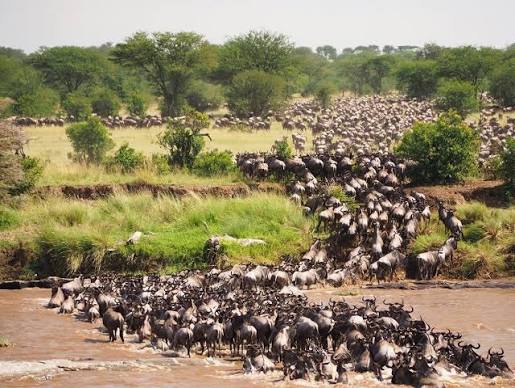
This is the moment most travelers picture when they imagine the Great Migration. From July through August, the herds reach the Mara River on the northern boundary between Tanzania and Kenya. The wildebeest gather in their thousands on the riverbanks, seemingly paralyzed by instinct and fear, before one animal finally leaps into the crocodile-filled waters — and thousands follow in a breathtaking stampede.
These crossings are unpredictable. They can happen multiple times a day, or not at all. That unpredictability is part of what makes witnessing one so profoundly moving. The Northern Serengeti — particularly areas around Kogatende Airstrip — offers some of the finest river-crossing viewing in the entire ecosystem.
Important note for 2026/2027 travelers: July and August are the most popular and most expensive months for Tanzania safaris. Book your accommodation and flights well in advance — ideally 9 to 12 months ahead.
Ideal for: Travelers with a specific bucket-list goal, those with flexible schedules who can wait for a crossing, and seasoned safari-goers.
September – October: Crossings Continue, Crowds Begin to Thin
Where: Northern Serengeti and Mara River
September and early October can actually offer some of the best river-crossing experiences of the entire year. The herds are still present in the north, the weather remains dry, and the intense peak-season crowds begin to ease slightly. Camps and lodges remain busy, but the atmosphere is marginally more relaxed.
By late October, the herds start sensing the approaching short rains to the south and begin their return journey — another remarkable display of instinctive navigation.
Ideal for: Travelers who want peak-season drama with slightly fewer crowds and sometimes better value.
November – December: The Short Rains and the Return South
Where: Eastern Serengeti, moving toward the southern plains
November brings the short rains, and the herds begin their return to the southern Serengeti and Ndutu area. The landscape transforms quickly into a vivid green, and the animals spread out across wide plains. While river crossings are largely over, the sheer scale of the moving herds — seen against stormy, dramatic skies — creates stunning photographic conditions.
December is a wonderful time for families traveling during school holidays who want a quieter, more affordable introduction to migration wildlife.
Ideal for: Families, photography enthusiasts, and travelers seeking value without sacrificing quality.
Where Exactly Is the Great Migration in Tanzania?
The Great Migration takes place almost entirely within the Serengeti National Park, one of Africa’s most iconic and well-managed wildlife reserves. The specific zones vary by season:
- Southern Serengeti / Ndutu — January to March (calving)
- Central Serengeti — March to May (transition)
- Western Corridor / Grumeti — May to June
- Northern Serengeti / Mara River — July to October
The herds also briefly enter Kenya’s Masai Mara during the peak July–October crossing season, but the majority of the migration journey — and all of the calving season — occurs within Tanzania.
The Best Time to See the Great Migration: Our Expert Recommendation
There is no single “best” time — it depends entirely on what you want to see:
| Experience | Best Months | Location |
| Calving season & predator action | January – February | Southern Serengeti |
| Green season value & birdwatching | March – May | Central Serengeti |
| Grumeti River crossings | May – June | Western Corridor |
| Mara River crossings (peak drama) | July – September | Northern Serengeti |
| Return migration & green scenery | November – December | Eastern/Southern Serengeti |
If you can only visit once, July through September offers the highest probability of witnessing a Mara River crossing. If budget is a consideration or you prefer fewer crowds, January – March or November deliver exceptional experiences at a lower price point.
Planning Your 2026/2027 Great Migration Safari
How Many Days Do You Need?
To maximize your chances of witnessing a river crossing or experiencing multiple phases of the migration, we recommend a minimum of 7 to 10 days in Tanzania. A well-designed itinerary might combine the Serengeti with the Ngorongoro Crater and perhaps a beach stay in Zanzibar.
Our East Africa Safari Itinerary 10 Days: 2026 Ultimate Guide offers a detailed, expert-curated 10-day route that covers the highlights of Tanzania beautifully.
Accommodation Tips
During peak migration season (July–September), accommodation in the Northern Serengeti is limited and in extremely high demand. We strongly recommend choosing between:
- Permanent tented camps near the Mara River (book 9–12 months ahead)
- Mobile camps that follow the herds (flexible but require early booking)
- Lodge-based safaris in Seronera with day trips north (more affordable)
Traveling from Europe or Further Afield?
For our German-speaking clients and European travelers more broadly, we have created a dedicated resource. Our Tanzania Safari German Travelers: 2026/2027 Ultimate Guide covers visa requirements, flight connections, health preparations, and much more.
Why Book Your Great Migration Safari with Golden Trips Tanzania?
At Golden Trips Tanzania, we specialize exclusively in Tanzania, and we know this land intimately. Here is what sets us apart:
- Local expertise: Our guides are Tanzanian-born professionals with deep knowledge of the Serengeti ecosystem and animal behavior.
- Flexible itineraries: We tailor every safari to your interests, budget, and travel dates — no cookie-cutter packages.
- Transparent pricing: No hidden fees. What you see is what you pay.
- Multilingual support: We work comfortably with travelers from the USA, Germany, France, Italy, Spain, the Netherlands, Japan, and Russia.
- Sustainable tourism: We are committed to responsible, community-supporting safari practices that protect Tanzania’s wildlife for future generations.
Explore our full range of carefully crafted options on our Tanzania Safari Packages page, or contact us directly to begin planning your personalized journey.
Frequently Asked Questions
Q: Can I guarantee seeing a river crossing?
A: Unfortunately, no. The crossings are entirely unpredictable and driven by animal instinct. However, spending 3 or more days camped near the Mara River in July–September gives you an excellent probability of witnessing at least one crossing.
Q: Is the Great Migration only in Tanzania?
A: The migration passes through both Tanzania (Serengeti) and Kenya (Masai Mara). The majority of the journey — including calving season — takes place in Tanzania.
Q: What is the cheapest time to see the migration?
A: The green season months of March–May offer the lowest accommodation prices while still providing a chance to see large herds on the move.
Q: Do I need to be physically fit for a Great Migration safari?
A: Safari game drives are suitable for almost all fitness levels. Activities are primarily conducted from vehicles. Some walking safaris and balloon rides are available for those seeking more active experiences.
Final Thoughts
The Great Migration is not just a wildlife event — it is a reminder of the raw, unstoppable power of nature. Witnessing it changes people. Whether you choose the tender vulnerability of calving season, the heart-pounding drama of a Mara River crossing, or the quiet majesty of thousands of animals moving across a rain-freshened plain, Tanzania will leave you forever altered.
2026/2027 is a wonderful year to make it happen. The earlier you plan, the better your options — and we are here to help every step of the way.
Ready to start planning your Great Migration safari? Visit our Tanzania Safari Packages page or reach out to the team at Golden Trips Tanzania today. Your adventure awaits.